Honest Review · Vagus Nerve Stimulator
I Wore the Pulsetto FIT for 3 Weeks. Here's My Honest Review.
"It was the third night that week I'd watched the ceiling at 3 a.m. that I finally ordered one." Pulsetto reviews are everywhere right now — the brand claims 100,000+ customers and 20,000+ five-star ratings. I wanted to know what's actually true. So I wore this vagus nerve stimulator through work deadlines, a brutal sleep week, and one very stressful Tuesday. This is everything I learned — the good, the annoying, and the honest maybe.

If This Sounds Familiar
Tired all day. Wired all night.
You know the cycle. The workday ends but your brain doesn't get the memo. You lie down and suddenly it's a highlight reel of unanswered emails, tomorrow's meeting, that thing you said in 2019. Your body is exhausted; your nervous system is still sprinting.
The problem usually isn't that you don't want to relax. It's that your body has forgotten how to switch off.
That's the itch products like Pulsetto promise to scratch: instead of telling you to "just meditate" (which, if your mind races, feels impossible), it targets the hardware — the vagus nerve, the main off-switch cable of your nervous system. The question I set out to answer: does a $260 collar actually help flip that switch, or is it just an expensive placebo with a nice app? Let's get into it.
What It's Built For
Deep calm, better sleep, a quieter mind — in 4-minute doses
The five free app programs each target one of the moments people actually buy this for. Here's where the FIT aims — and, spoiler from my test, where it landed for me.
Soothe stress
The 4-minute "exhale" after a wired day — the effect I felt most consistently
Fall asleep faster
The Sleep program before bed — worked on about half my nights, starting around night 9
Calm the racing mind
Worry & overwhelm program for the 3 a.m. highlight reel
Ease burnout
Recovery sessions on the heavy weeks — slower burn, not a magic reset
The 60-Second Science Primer
What is vagus nerve stimulation, actually?
The vagus nerve is the longest cranial nerve in your body — it runs from the brainstem down both sides of your neck into your chest and gut. It's the main highway of the parasympathetic nervous system, the "rest and digest" mode that's supposed to counterbalance fight-or-flight. When you sigh deeply and your shoulders drop? That's your vagus nerve doing its job.
Transcutaneous vagus nerve stimulation (tVNS) uses mild electrical pulses through the skin — at the neck or ear — to nudge that nerve without surgery or implants. The theory: regular stimulation helps shift the body toward a calmer state — slower heart rate, steadier breathing, better heart rate variability (HRV), which researchers use as a rough gauge of stress resilience. The field has real published research behind it. Whether a consumer neck-worn device delivers those lab results is the part worth being skeptical about — and I'll get to that.
The Device
What is the Pulsetto FIT?
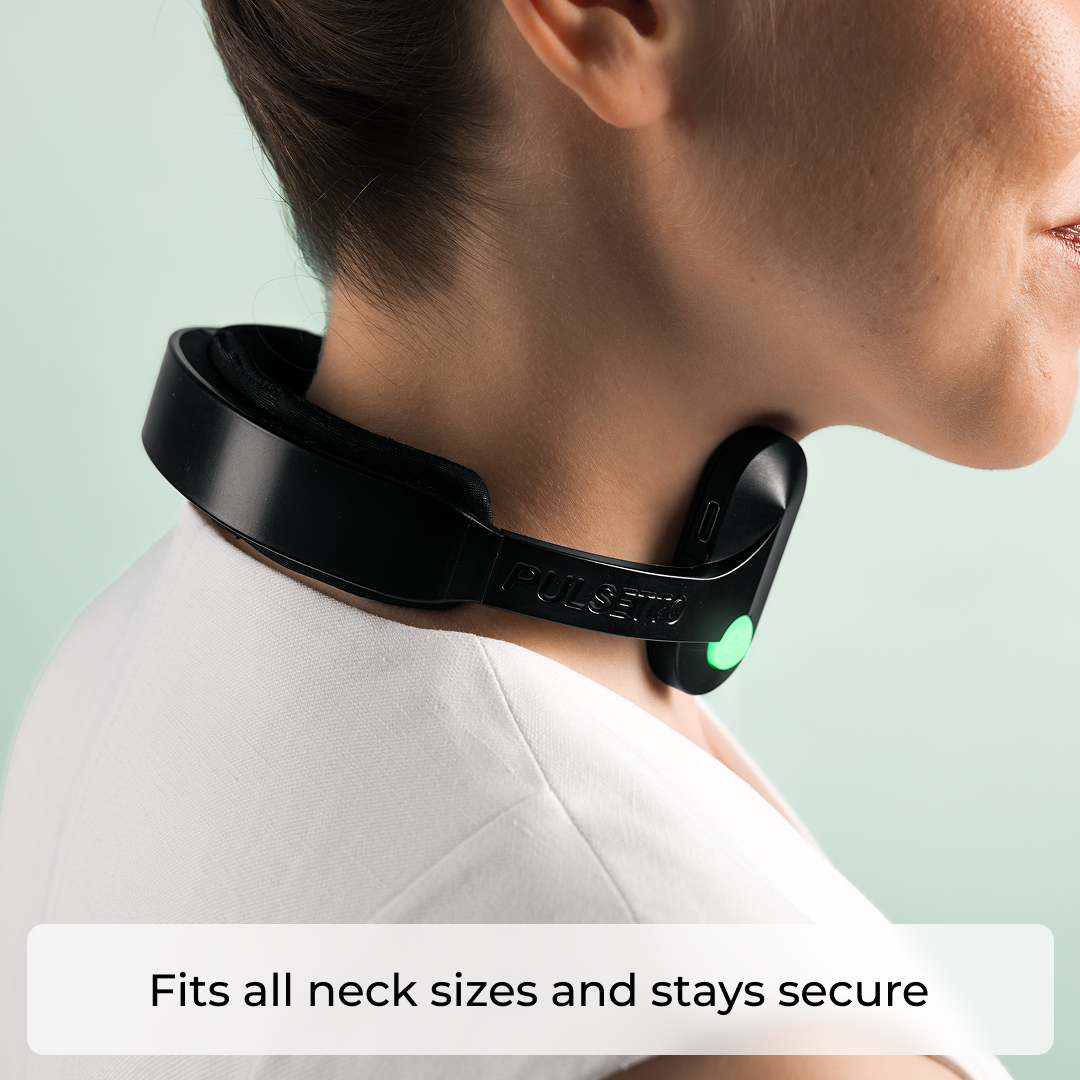
The FIT is Pulsetto's newest model: a wireless collar you wear around the back of your neck, with two pads that sit over each side of the throat. It stimulates both sides at once (bilateral), which most handheld competitors don't. You control everything from the phone app — pick a program, set the intensity, and the session runs itself. Most sessions are about 4 minutes; you literally can't do it wrong.
Versus the standard Pulsetto, the FIT gets three real upgrades. A bigger battery — the brand rates it at up to 12 days of daily use (roughly 20 sessions) per charge. Two extra neck pads, so it fits slimmer or larger necks properly instead of one-size-hopefully-fits-all. And a different stimulation pattern: instead of a constant buzz, the FIT's pulses rise and fall like a slow wave — a detail that sounds like marketing until you feel it, and then it's the thing you'd miss going back. The free app includes five programs — stress, worry, sleep, burnout, and pain relief — plus soundscapes. There's an optional premium tier (~$89/year) with extra programs, breathing exercises, and HRV tracking via Oura Ring or Apple Watch. You don't need it; the free tier covers the essentials.

What's in the box
- Pulsetto FIT device
- Conductive gel
- USB-C cable
- 2 extra neck pads
- User manual
- Free app access
- StimulationBilateral cervical tVNS (electrical)
- Session lengthFrom ~4 minutes
- BatteryUp to 12 days / ~20 sessions, USB-C
- Stimulation feelWave-like, rises and falls (not a constant buzz)
- AppiOS & Android, Bluetooth
- CertificationsFCC & CE
- Guarantee30-day money-back + 2-year warranty
Dead Simple
How a session actually goes
This was my whole routine, every evening. Total honest time commitment: about five minutes, including finding the gel.
Dab the gel
A pea-sized amount on each contact pad. It's cold, it's slightly annoying, and yes, you need it every time — without it the connection drops.
Collar on, pads on your neck
The FIT sits around the back of the neck like reversed headphones. The two pads rest over each side of your throat. With the right padding insert it stays put.
Pick a program, press start
Choose Stress, Sleep, or another program in the app and ramp the intensity until you feel a gentle tingle. Then just sit there for 4 minutes. That's it.

The Actual Test
My three-week diary, unedited
"That's... a weird feeling."
First session: gel on, collar on, intensity up — and a soft tingling spreads across both sides of my neck, swelling and fading in slow waves rather than buzzing flat. Not painful, not a shock. Closest description: a faint fizzing, like a very polite pins-and-needles. At level 4 it was uncomfortable; at level 2 it was almost pleasant. I finished the 4 minutes and felt... fine? Maybe a little looser in the shoulders. Maybe imagination.
Honest note from day 2: I almost quit the gel step. It's cold and mildly annoying. You get used to it, but nobody tells you that part.
The first genuinely good night
I anchored the session to my wind-down: phone away, Sleep program, book. On night 9, I fell asleep without the usual 40-minute mental inbox review — first time in weeks. Was it the device? The routine? Both? I genuinely can't separate them, and I'm suspicious of anyone who claims they can.
What I can say: on session days I felt a real "exhale" moment right after — the same drop your shoulders do at the end of a massage. On two hectic days I skipped it and missed it, which surprised me.
Not a miracle. A tool.
I wanted this to be a miracle. It isn't. Some days the 4 minutes felt transformative; other days it was just a tingly pause in my evening. The real test came on a Tuesday when everything at work broke at once: I locked my office door, ran a Stress session before the crisis call, and walked in noticeably less shaky. One anecdote isn't data — but that's the day it earned its spot on my desk.
My unscientific scorecard after 21 days: noticeably calmer evenings on most days, faster sleep onset on maybe half the nights, zero side effects beyond gel-related mild annoyance.

The app tracks your streak — a small thing, but it's half the reason I stayed consistent past week one.
Honest Take
The science: what's real, what's still early
Here's where I put my skeptic hat back on. tVNS as a field has a legitimate and growing body of published research — mostly on HRV, stress markers and sleep, in small to mid-sized studies. The mechanism is real. The open question is whether this specific consumer device reproduces those effects.
Source: Pulsetto's own 14-day user study (1,000+ participants), self-reported results — not an independent clinical trial, and not a promise of your results.
Two more things I'd want to know as a buyer. One: the brand leans on endorsements from longevity figures like Peter Diamandis and Ben Greenfield — real people, but endorsements in this space are routinely paid, so I weigh them as marketing, not evidence. Two: the device is FCC and CE certified as an electronic product, which speaks to safety standards — not to effectiveness. My honest summary: the mechanism is legitimate, the device-specific evidence is young, and my own three weeks landed somewhere between "placebo with great ergonomics" and "genuinely useful nightly reset." For a wellness gadget with a 30-day return window, that was enough for me to keep it.
How It Stacks Up
Pulsetto FIT vs. Truvaga Plus vs. Sensate vs. Apollo Neuro vs. Nurosym
I compared the FIT against the four devices people most often cross-shop. Short version: it's the most affordable of the electrical (tVNS) options, and the only hands-free bilateral one.
| Device | Method | Approx. price | Scientific backing | Subscription | Portability |
|---|---|---|---|---|---|
| Pulsetto FIT | Bilateral cervical, electrical | ~$260 | General tVNS research; device-specific studies limited (company-run) | None required; optional premium app (~$89/yr) | Neck-worn, wireless, hands-free |
| Truvaga Plus | Handheld, electrical (neck contact) | ~$499 | Some device-specific clinical data | None | Handheld, pocket-sized |
| Sensate | Vibroacoustic, chest-worn | ~$325 | Limited peer-reviewed data | Optional app subscription | Small pendant, no gel needed |
| Apollo Neuro | Vibration, wrist/ankle wearable | ~$349 | Peer-reviewed pilot studies on HRV | Free app; none required | All-day wearable |
| Nurosym | Electrical, ear-clip (auricular tVNS) | ~$750 | Strongest clinical/academic backing in this category | None | Ear-clip + separate controller |
Prices are approximate official-site listings at time of writing and change with promotions. Confirm current pricing before purchase.
After 21 Days
What I loved. What annoyed me.
Loved
- Hands-free and bilateral — I read a book while it runs; handhelds can't do that
- 4-minute sessions are short enough that I actually did them daily
- Battery is a non-issue: charged it twice in three weeks (USB-C)
- Two extra neck pads meant it fit my neck properly — and my partner's
- ~$260 one-time; the free app tier genuinely covers everything essential
- 30-day money-back + 2-year warranty made trying it feel zero-risk
Annoyed me
- The gel. Every session. It's cold, and you'll forget it exists until the pads won't connect
- You have to sit still — this is a pause button, not a wear-it-while-cooking device
- Device-specific evidence is still mostly the company's own studies
- The best extras (HRV tracking, more programs) sit in the ~$89/yr premium tier
- Results were inconsistent day to day — some sessions felt like nothing
- It's a wellness tool, not a treatment — anyone promising more is overselling
Beyond My Experience
Pulsetto reviews: what other users report
My three weeks are one data point. Before and during the test I read through a wide sample of Pulsetto reviews across the official site, app stores and independent forums. The scale numbers below are the brand's own claims; the themes are what kept repeating.
Figures claimed by Pulsetto; independent verification not available.
"Took about two weeks of consistent use before I noticed anything with my sleep. Not a miracle, but I do fall asleep faster on nights I use it."
"Works fine but the gel step gets old fast. I wish it didn't need reapplying every session. Still use it before stressful meetings though."
"Had an issue with my app pairing and their support team actually walked me through it same day. That alone made me trust the company more."
"Some days I feel noticeably calmer after, other days nothing. I've kept it in my evening routine anyway since the sessions only take four minutes."
Reviews reflect individual experiences and personal opinions, not clinical outcomes. Results vary.
Fit Check
Who should buy it — and who shouldn't
Get it if you...
- Deal with everyday stress, a racing mind at bedtime, or that wired-but-tired feeling
- Want a drug-free anchor for a wind-down routine you'll actually keep
- Are fine with a device + app combo and a 4-minute daily habit
- Want the cheapest serious entry into tVNS without a $500–750 commitment
Skip it if you...
- Have a pacemaker or any implanted electronic medical device
- Have epilepsy or a seizure history (talk to your physician first)
- Are pregnant, or managing an active diagnosed medical condition
- Expect a substitute for professional medical or mental health care — it isn't one
Current Pricing
What it costs right now
Pricing on the official site when I published this review. Fair warning: the $350-off promo was live at the time of writing, and Pulsetto rotates these offers without notice — I've seen the single-unit price sit higher between sales. Every option carries the same 30-day money-back window, so the safest move is checking what's live today.
Buy 1, Get 1 50% Off
Prices are approximate and promotional at the time of writing; the official site shows current offers.
After 21 Days
My verdict: a tool, not a miracle — and I'm keeping it
Three weeks in, the Pulsetto FIT earned a permanent spot on my nightstand — not because it changed my life, but because it reliably gives me a four-minute off-ramp at the end of a wired day, and some nights that's the difference between falling asleep at 11 and at 1. The science on this specific device is younger than the marketing suggests, and I've told you exactly where. But at ~$260 with a 30-day money-back guarantee, a 2-year warranty and free shipping, you can run the same two-week experiment I did with essentially nothing to lose. If your nervous system has forgotten where the off switch is, this is a reasonable place to start looking.
Questions I Had Too
Frequently asked questions
How much does Pulsetto FIT cost?
At the time of writing, the official site lists a single Pulsetto FIT at around $260 (down from a $610 list price), with bundles — a second unit at 50% off, or a third free when buying two. Shipping is free and no subscription is required. Prices rotate with promotions, so confirm the current offer on the official site.
Does it actually work?
The honest answer: tVNS as a technique has real research support for stress and HRV, but independent studies on this specific device are still limited. In my three weeks, I noticed calmer evenings on most days and faster sleep onset on about half the nights — consistent, but not universal. Treat it as a wellness tool worth testing inside the 30-day return window, not a guaranteed fix.
What does it feel like?
A gentle tingling on both sides of the neck that swells and fades in slow waves — strange for the first minute of your first session, then genuinely unremarkable. You control the intensity in the app; lower levels are borderline pleasant, and you should never push it to uncomfortable.
How long before I notice anything?
For me, the immediate post-session "exhale" was there from week one, but the sleep effect only showed up around day 9–10 of consistent daily use. That matches both the user reviews I read and the brand's own study, which measured self-reported changes over a 14-day period.
Is it safe?
It's a general wellness device using low-level electrical stimulation, FCC and CE certified. It is not recommended for anyone with a pacemaker or other implanted electronic device, epilepsy, or during pregnancy — and it isn't a substitute for medical care. If you have an existing condition, check with a physician first.
Is there a guarantee? Do I need a subscription?
The official site lists a 30-day money-back guarantee plus a 2-year device warranty. No subscription is needed: the free app includes the five core programs. An optional premium tier (~$89 for 12 months) adds extra programs, breathing exercises, meditations and HRV tracking with Oura Ring / Apple Watch — nice to have, not required.